The call came in early in the morning, and from the first description alone, emergency responders knew this would not be an ordinary rescue. A small puppy had been found trapped in a thick, black, sticky substance near an industrial area on the outskirts of town. From a distance, the material looked like hardened tar or resin, likely a byproduct of nearby industrial or mining activity. Up close, the reality was even more alarming.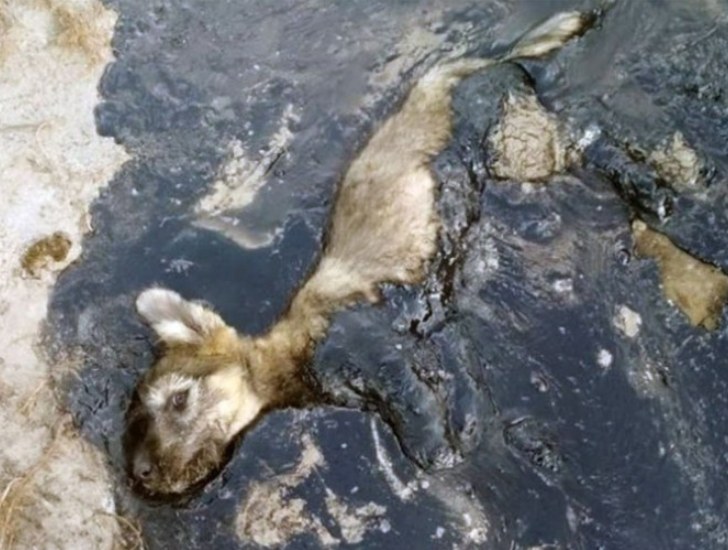
When firefighters and animal rescue workers arrived at the scene, they found the puppy nearly immobilized. His legs were stuck fast, his fur coated in the dark substance, and panic was visible in his wide eyes. Every small movement only caused him to sink deeper. Beneath his body, the tar-like material had begun to give way, forming a shallow hole that threatened to pull him under completely if nothing was done.
Time was the greatest enemy. As the substance cooled and hardened, it tightened its grip, making each passing minute more dangerous. The puppy was exhausted, dehydrated, and trembling. Rescuers understood that pulling him out too quickly could cause severe injuries, while waiting too long could cost him his life.
The team quickly secured the area and began assessing their options. Water was ruled out immediately, as it could cause the material to harden further. Chemical solvents were considered but rejected due to the risk of toxic exposure to the puppy. Instead, the rescuers opted for a painstaking, manual approach that required patience, precision, and steady hands.
Firefighters carefully stabilized the surrounding surface to prevent further collapse. Using small tools, they slowly chipped away at the hardened substance around the puppy’s legs and chest. At the same time, animal rescuers spoke softly to him, trying to keep him calm. Despite his fear, the puppy did not bite or struggle violently. He seemed to sense that help had finally arrived.
The rescue lasted over an hour. Progress was slow, and there were moments when it appeared the puppy might not make it. The hole beneath him widened slightly, and rescuers had to adjust their strategy, supporting his body to keep him from sinking further. Every movement was deliberate. One wrong decision could have caused the hardened material to shift suddenly, trapping him beyond recovery.
Finally, after what felt like an eternity, the puppy’s legs came free. Covered in black residue and barely able to stand, he was gently lifted from the trap and wrapped in a clean blanket. Applause broke out among the responders and onlookers who had gathered nearby. Against the odds, the puppy was alive.
He was rushed immediately to a veterinary clinic, where staff began the long process of removing the tar-like substance from his fur and skin. The material had bonded tightly, requiring hours of careful cleaning to avoid damaging his skin. Vets confirmed that while he was exhausted and mildly injured, he had avoided any life-threatening damage thanks to the careful rescue.
In the days that followed, the puppy began to recover. As the last traces of the substance were removed, his personality started to emerge. He became more alert, curious, and affectionate, surprising everyone who had first seen him terrified and trapped. His resilience quickly became a source of inspiration for the rescue team.
Investigations into the source of the hazardous material are ongoing, with authorities examining whether safety regulations were violated. For rescuers, the incident highlighted a growing concern about industrial waste and its hidden dangers to animals and the environment.
Today, the puppy is safe, warm, and under close veterinary care. Though his future is still being decided, one thing is certain: he survived because a group of people refused to give up, even when the odds were stacked against him.
This rescue is a powerful reminder of how fragile life can be — and how compassion, patience, and teamwork can turn a moment of despair into a story of hope.