When Spencer was first discovered, it was hard to believe he was still alive. His body was dangerously thin, his ribs sharply visible beneath fragile skin, and his spine bent in a way that told a silent story of long-term suffering. He lay motionless, barely reacting to the world around him, as though pain had drained him of the strength to hope. For those who found him, it was clear that Spencer had endured far more than any animal ever should. 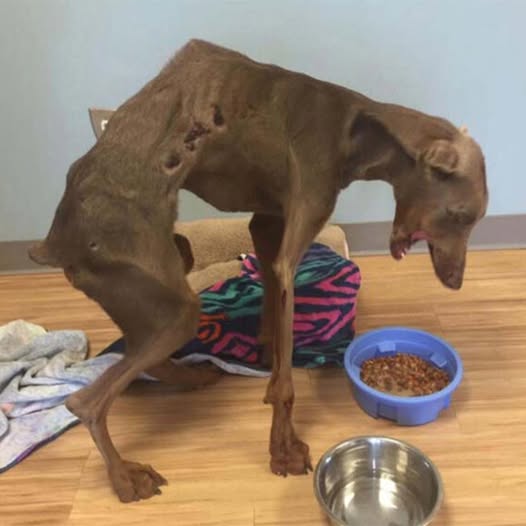
Veterinarians later confirmed the severity of his condition. Prolonged malnutrition had weakened his bones and muscles, and the curvature of his spine suggested years of neglect. Walking caused him pain, and even standing required effort. Yet despite everything, Spencer showed no aggression or fear. Instead, his eyes followed every movement gently, as if he was still searching for kindness in a world that had failed him.
The rescue team moved quickly, knowing time was critical. Spencer was transported to a clinic where specialists worked carefully to stabilize him. Food was introduced in small amounts, fluids restored his strength, and medication eased his discomfort. But healing Spencer was never just about physical treatment. From the very beginning, it was clear that he needed patience, reassurance, and emotional safety just as much as medical care.
In the early days, progress was slow. Spencer slept often, conserving energy as his body adjusted to nourishment for the first time in what was likely years. Volunteers sat beside him, speaking softly, letting him know he was no longer alone. At first, he barely responded. Then one day, he lifted his head and gently nudged a hand resting near him. It was a small gesture, but for those watching, it felt like a breakthrough.
As weeks passed, subtle changes began to appear. Spencer gained weight gradually, and his coat started to regain its shine. Physical therapy helped him strengthen his legs and improve his mobility. Each step forward was carefully supported, and each success, no matter how small, was celebrated. His spine would never be completely straight, but the pain lessened, and his confidence grew.
What surprised everyone most was Spencer’s personality. As his strength returned, so did his joy. He began to wag his tail when caregivers entered the room. He leaned into affection, seeking comfort rather than avoiding it. Despite his past, Spencer showed an incredible capacity for trust. He seemed to understand that he had been given a second chance and embraced it fully.
His story soon reached beyond the clinic. Photos and updates were shared, and people from all over followed his journey. Many were moved not only by how far Spencer had come, but by what he represented. He became a symbol of resilience, showing that even the most broken beginnings do not have to define the end.
Eventually, Spencer was ready for the next chapter of his life. He was introduced to a calm, loving family who understood his needs and his limits. The meeting was quiet and unforced. Spencer walked over, slowly but confidently, and rested beside them. It was clear he had found a place where he belonged.
Today, Spencer’s life looks very different from the day he was found. He enjoys gentle walks, warm beds, and moments of play that once seemed impossible. His spine may still curve, a reminder of his past, but it no longer defines him. What defines Spencer now is his joy, his affection, and his ability to love deeply.
Spencer’s journey is a powerful reminder that healing is possible, even after unimaginable pain. With compassion, patience, and a willingness to act, lives can be transformed. Spencer did not just survive — he learned how to live again, proving that second chances can change everything.